From Mill Gates to Ganesh
Walk through Lalbaug’s mills, chawls, markets, unions, and idol workshops
- Mumbai, India
- 12 stops
- 216 min
- 8.6 km
- History
Try the first stop
Damodar Hall
A landmark where mill workers encountered theatre, reform, politics, and Ambedkar.
Damodar Hall reveals how Parel’s workers became an engaged political and cultural public. Associated with Dr. B. R. Ambedkar, social reform, public meetings, and Marathi theatre, it hosted ideas that challenged both labor exploitation and caste inequality. From the street, imagine audiences gathering here after demanding mill shifts.
The route
12 stops, in order.
- 1Stop 1 · Free sample
Damodar Hall
A landmark where mill workers encountered theatre, reform, politics, and Ambedkar.
- 2Stop 2
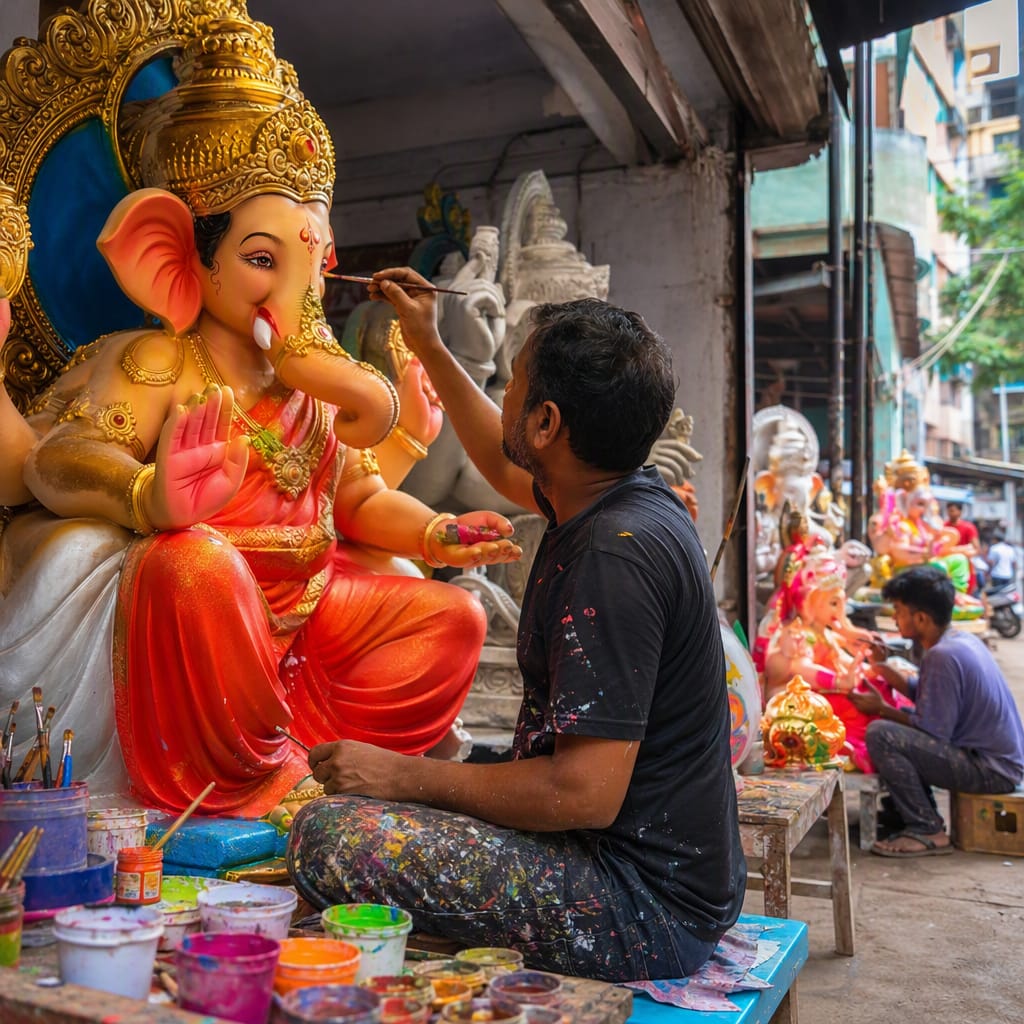
Dattaram Lad Workshops
Seasonal workshops turn industrial craft discipline into Mumbai’s monumental sacred sculpture.
- 3Stop 3
Parel Railway Workshop
A surviving engineering complex keeps Parel’s skilled industrial labor story alive.
- 4Stop 4
Mazdoor Manzil
A union headquarters embodying Mumbai’s powerful and contested textile labor movement.
- 5Stop 5
Nare Park
Parel’s shared backyard for recreation, organizing, festivals, and neighborhood solidarity.
- 6Stop 6
Bharatmata Cinema
A beloved single-screen cinema preserving Lalbaug’s working-class Marathi entertainment culture.
- 7Stop 7
Tejukaya Mansion
A residential landmark where chawl networks power a celebrated community Ganesh festival.
- 8Stop 8
Ganesh Galli
An ordinary Lalbaug lane transformed annually into a monumental festival world.
- 9Stop 9
Lalbaugcha Raja
Mumbai’s famous neighborhood Ganesh grew from traders’ hopes and working-class solidarity.
- 10Stop 10
Lalbaug Market
A bustling neighborhood market connecting mill families, traders, food, and festival history.
- 11Stop 11
Abhyudaya Nagar
Planned housing shows how working-class community life continued beyond older chawls.
- 12Stop 12
India United Mills Gate
A monumental mill remnant closes the walk with memory, loss, and contested futures.
The app guides you from stop to stop with GPS and plays each story when you arrive.